
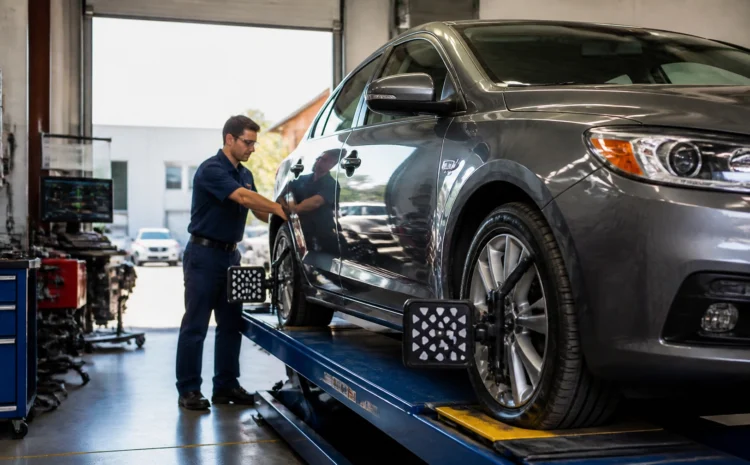
Wheel Alignment vs Tire Rotation: Which One Does Your Dover Car Really Need?
Have you been told your car needs a tire rotation: or possibly a wheel alignment: and wondered if they are the same service?
You are not alone. Many Dover drivers use these terms interchangeably. But they solve two different problems!
A tire rotation moves your tires to different positions on the vehicle. A wheel alignment adjusts suspension angles so your wheels point and track correctly.
Both services protect your tires. Both can improve your drive. But knowing which one you need can save you money and help you avoid unsafe handling.
Here is how to tell the difference.
Wheel Alignment vs. Tire Rotation: The Simple Difference
Think of your tires as the shoes on your vehicle.
- Tire rotation changes which “shoe” is on each corner.
- Wheel alignment corrects the direction and angle of each wheel.
A rotation does not adjust your suspension. An alignment does not move your tires around the vehicle. They are separate services, even though a shop may recommend checking both at the same visit.
| Service | What it does | Main purpose |
|---|---|---|
| Tire rotation | Moves tires between front, rear, and sometimes side positions | Promotes even tire wear |
| Wheel alignment | Adjusts suspension angles, including camber, toe, and caster | Helps the car track straight and improves handling |
So, which does your Dover car really need? Start by looking at the symptoms and your maintenance schedule.
What Does a Tire Rotation Do?
Your tires do not wear evenly in their original positions.
Front tires usually work harder because they handle steering. On many front-wheel-drive vehicles, they also handle most of the engine’s driving force. That extra work can cause the front tires to wear faster than the rear tires.
A tire rotation moves the tires into different positions. This helps spread the workload across the full set.
Most manufacturers recommend rotating tires about every 5,000 to 7,500 miles, although your owner’s manual should be the final guide. Many drivers schedule a rotation with every other oil change.
You likely need a tire rotation if:
- Your tires have reached the recommended mileage interval.
- The front tires look more worn than the rear tires.
- You recently installed new tires.
- You notice uneven wear without pulling or steering problems.
- You want to get more usable life from the complete set.
Rotation is routine maintenance. You may not notice an immediate difference in how your car drives. The benefit comes over time, as your tires wear more evenly and last longer.
For more tire-care guidance, read our guide to tire service and maintenance.
What Does a Wheel Alignment Do?
A wheel alignment corrects the angles of the wheels and suspension. The goal is to bring those angles back to the vehicle manufacturer’s specifications.
The three main alignment angles are:
- Camber: The inward or outward tilt of the wheel when viewed from the front.
- Toe: Whether the front edges of the tires point slightly inward or outward when viewed from above.
- Caster: The forward or backward angle of the steering axis when viewed from the side.
These angles affect how your vehicle handles and how the tread meets the road.
When alignment is correct, your wheels should point in the proper direction, sit at the correct angle, and make even contact with the pavement. When alignment is off, your tires can scrub against the road. That creates rapid or irregular wear.
You may need a wheel alignment if:
- Your vehicle pulls left or right on a straight, level road.
- Your steering wheel sits crooked while you drive straight.
- Your tires show inside-edge, outside-edge, or feathered wear.
- Your car feels unstable or wanders at highway speeds.
- You hit a pothole, curb, or other hard road obstacle.
- You recently had steering or suspension work completed.
- You notice the vehicle does not return smoothly to center after a turn.
A wheel alignment is not simply “straightening the tires.” It is a suspension adjustment that requires proper measurements and equipment.
Why Dover Roads Can Affect Alignment
Kent County roads can be tough on vehicles. Potholes, uneven pavement, construction zones, and curbs can deliver a serious impact to your wheels and suspension.
What happens after you hit a pothole?
You might hear a loud impact and keep driving. But the force can shift an alignment angle, damage a tire, bend a wheel, or stress a steering component.
A single pothole does not automatically mean your alignment is damaged. However, you should pay attention afterward.
Check your vehicle for:
- New pulling to one side.
- A steering wheel that is no longer centered.
- New vibration or unusual road noise.
- A tire losing air.
- Fresh uneven wear along the tread.
- A change in how the vehicle handles turns.
If you notice any of these symptoms, schedule an inspection. A tire rotation will not correct an alignment problem caused by a pothole.
Our suspension repair service information explains why steering and suspension components matter to your vehicle’s control and safety.
Can a Tire Rotation Fix an Alignment Problem?
No. This is the most common misconception!
Rotating your tires changes their positions. It does not change the angles of the wheels.
For example, imagine your right-front tire is wearing heavily on its inside edge because of incorrect toe or camber. Moving that tire to the rear may temporarily change where you notice the wear, but it will not fix the cause. The tire may continue wearing abnormally in its new position.
Likewise, an alignment will not correct a tire that has simply been used in one position for too long. If your front tires are more worn than the rear tires, you may need a rotation: or possibly new tires if the tread is already too low.
Sometimes you need both services. A technician may recommend rotating the tires and performing an alignment check. That does not mean every vehicle needs an alignment adjustment. The alignment should be corrected only if measurements show it is outside the proper range.
Which Service Does Your Dover Car Need?
Use this quick guide to narrow it down.
Choose a tire rotation when:
- You have reached the mileage listed in your owner’s manual.
- Your tires are wearing evenly but the front and rear wear rates differ.
- You recently purchased or installed a new set of tires.
- You have no pulling, crooked steering wheel, or handling concerns.
Choose an alignment inspection when:
- Your car pulls to one side.
- The steering wheel is off-center.
- You see uneven, feathered, or edge wear.
- You hit a deep pothole or curb.
- You had tie rods, control arms, struts, or other suspension parts replaced.
- Your vehicle feels unstable or wanders.
Choose both when:
- Your tires are due for routine rotation and you are also experiencing alignment symptoms.
- You have just completed suspension repairs.
- You hit a major road impact and notice new tire or steering issues.
- You want a complete tire and steering check before a long trip.
Do not guess when tire safety is involved. Look at the tread, but also pay attention to how your vehicle feels on the road!
How Often Should You Schedule Each Service?
Your vehicle’s maintenance schedule should come first. Driving habits, tire type, vehicle design, and road conditions all affect service intervals.
As a general guide:
- Tire rotation: Every 5,000 to 7,500 miles, or as recommended by your vehicle or tire manufacturer.
- Alignment check: At least once a year or around every 10,000 to 15,000 miles, with an earlier check after a pothole impact or handling change.
You do not necessarily need an alignment adjustment at every mileage interval. An inspection can determine whether the angles are within specification.
Keep in mind that an alignment cannot repair a worn suspension component. If a tie rod or control arm is damaged, that issue may need to be addressed before the alignment can be completed correctly.
Why Professional Inspection Matters
It is easy to assume your vehicle needs a rotation when the real issue is alignment, tire damage, wheel balance, or suspension wear.
At First Class Car Care, our ASE-certified technicians inspect the full picture. We have more than 20 years of experience helping drivers in Dover, Delaware, maintain safe and dependable vehicles.
You receive:
- Clear findings in everyday language.
- Transparent pricing.
- A detailed estimate before work begins.
- Professional tire and suspension service.
- A commitment to 100% customer satisfaction.
We will not recommend an alignment simply because it is convenient. We will measure the vehicle, explain what we find, and help you choose the service that actually fits your needs.
If a tire or suspension problem leaves you stranded, our sister company, Harris Towing, can help with emergency towing. Even better, you can receive free towing with repairs!
Keep Your Tires Working Together
Tire rotation and wheel alignment are not the same thing.
Rotate your tires to help them wear evenly. Check your alignment when your vehicle pulls, your steering wheel sits crooked, your tread wears unevenly, or a Dover-area pothole gives your suspension a hard hit.
Need reliable wheel alignment in Dover, DE or professional tire repair in Dover, DE? Lean on the team at First Class Car Care! Contact our shop for a transparent estimate and experienced service that helps keep you safely on the road.