

Repair or Replace? The Honest Math for High-Mileage Cars in Dover, DE
Somewhere past 150,000 miles, every driver faces the same question. The car needs another repair. Do you pay for it, or is this the moment to walk away?
It's a harder question than it looks. The answer isn't hiding in your odometer, and it isn't in your gut either. It's in the numbers, and in what kind of shape the rest of the car is in.
Let's work through it the way we'd work through it with you at the counter.
First, sort the repair from the failure
Not every big bill means the same thing. Two $1,200 repairs can tell completely different stories.
Maintenance is work that wears out on a schedule. Timing belts, water pumps, struts, brakes, batteries, hoses. Painful to pay for, but you know the new part is good for another long stretch. That's money going into a car that keeps running.
A failure is different. Transmission slipping, a head gasket letting coolant into the cylinders, a cracked block, rust eating the subframe. These are the repairs that often signal the end, because they're expensive and they rarely travel alone.
Ask your technician which one you're looking at. Be direct about it. A timing belt at 160,000 miles on a car that's otherwise solid is a very different decision from a transmission on the same car.
The annual repair number nobody calculates
Here's the math most people skip. Add up what you've spent on repairs over the last twelve months, not counting tires or oil changes. Then compare that number to what twelve months of car payments would cost you.
Say you've spent $1,400 keeping an older car on the road this year. A modest new-car payment runs several times that over the same period, before insurance, before the higher registration, before the first depreciation hit. On pure cash flow, the older car often wins by a wide margin.
That's the honest version of the argument. Repairing an older car usually costs less per month than replacing it. What it doesn't buy you is certainty.
Where the 50% rule falls short
You've probably heard the rule of thumb: don't spend more than half the car's value on a single repair. It's a reasonable starting point and a terrible finish line.
A car worth $5,000 that needs a $3,000 transmission is an easy no. Clear enough. But a car worth $5,000 that needs $2,400 of maintenance you were going to face on any car eventually, brakes, struts, a timing belt: that's not the same decision at all, even though the number is close.
The rule also ignores how the car has been treated. Which brings us to the part that matters most.
Mileage is a number. Condition is a story.
A well-maintained 180,000-mile car is frequently a better bet than a neglected 95,000-mile one. That's not a slogan. It's what the inspection report shows you.
Ask yourself a few blunt questions. Has the oil been changed on schedule? Are there records? Does it burn oil between changes? Is the transmission fluid original at 170,000 miles? Does the interior look like someone cared, or like a dog lived in it? Has it spent five winters on treated Dover roads without anyone rinsing the underside?
There's no universal mileage where a car stops being worth fixing. Plenty of vehicles run well past 200,000 miles with ordinary care. Plenty of others are finished at 90,000 because nobody opened the hood. The odometer tells you how far it's been. The records and the inspection tell you how much life is left.
Watch for the sunk cost trap
This is the emotional part, and it catches smart people.
You've already put $2,800 into this car this year. Walking away now feels like wasting that money. So you approve another $1,500, partly to justify the first $2,800.
That money is gone either way. It doesn't belong in the decision. What belongs in the decision is this: knowing what you know now, would you buy this car today for the cost of the next repair? If the answer is no, the previous spending doesn't change it.
Make the decision with real numbers in front of you
Here's where a lot of drivers get stuck. They can't do the math because they don't know what's actually wrong or what it will cost. They're guessing, and guessing leads to either panic or denial.
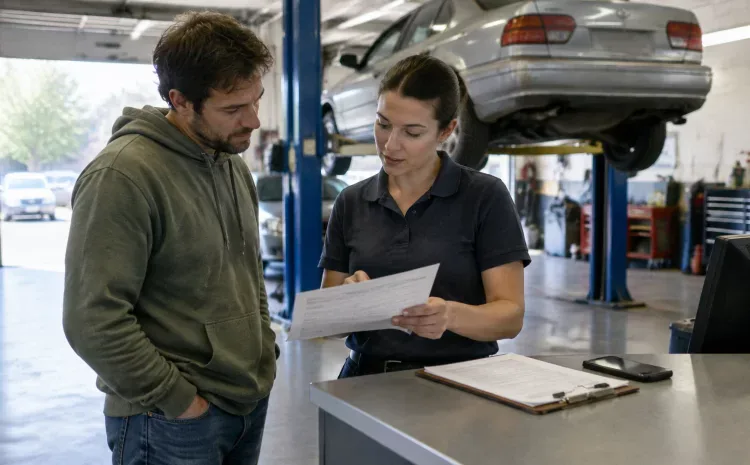
A complete vehicle inspection changes that. Ours covers the basics, fluids, belts, hoses and wiring, steering and suspension, tires, and the brake system. You find out what needs attention now, what can wait, and what isn't worth doing at all.
Then you get a detailed estimate before any work begins. That's the number you need. Not a range, not a guess, not a quote that grows after the car is already apart.

With that in hand, the decision stops being emotional. You either spend a known amount on a car you understand, or you spend a different amount somewhere else. Either way, you're choosing instead of reacting.
A few honest rules of thumb
If you want something to hold onto while you decide:
- One repair that costs more than the car is worth, and isn't maintenance: usually time to move on.
- A steady drip of small repairs across a year that still totals less than car payments: usually keep it.
- Structural rust, repeated transmission trouble, or overheating that keeps coming back: those are the ones that rarely end well.
- A clean inspection and solid records on a high-mileage car: that car has more to give, and it's usually cheaper than the alternative.
The decision is yours, the information shouldn't be a mystery
Nobody at our shop is going to tell you to replace a car you love, or to keep one you've quietly given up on. What we can do is tell you exactly what's wrong, what it will cost, and what we'd do in your position.
First Class Car Care has been working on Dover vehicles for more than 20 years, with ASE-certified technicians and a detailed estimate before any work starts. If your car can't make it in, our sister company Harris Towing handles the tow, and it's free with repairs.
Bring it by at 5360 N Dupont Hwy, Dover, DE 19901, or call 302-736-5473. We're open Monday through Friday, 8 AM to 5 PM. Let's put real numbers in front of you and let the math do the arguing.